|
 |
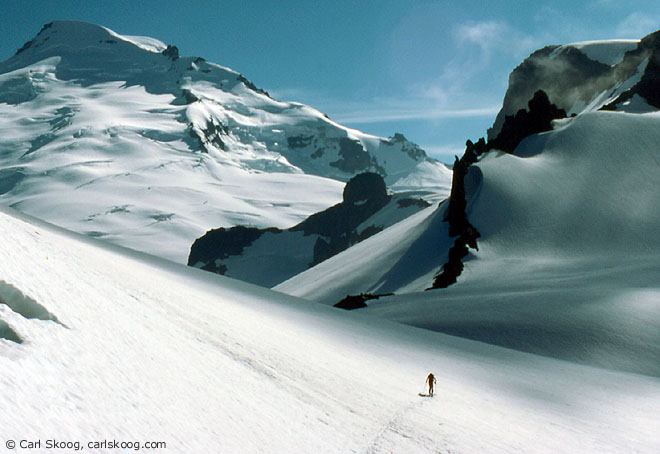
| Traversing toward Epley Portal with Mount Baker in the background, June 1990. (Map, 400kb) |
 |
|
The earliest recorded skiing in the Washington Cascades was in 1893. Brief newspaper stories describe miners using skis that winter at Silver Creek in the mountains above Index. No one knows exactly when recreational skiing got started, but it was certainly underway by 1909, when University of Washington Professor Milnor Roberts and a group of friends spent a holiday skiing at Longmire on Mount Rainier. By the 1930s, recreational skiing was booming, with most of the action at the now-familiar ski areas of Mount Baker, Stevens Pass, Snoqualmie Pass, and Paradise.
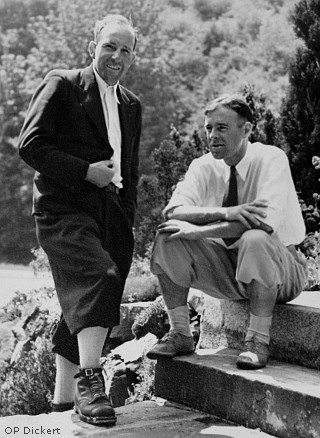
A few hardy ski mountaineers tackled the Cascade volcanos during the 1930s. Mount Baker was conquered on skis in 1930, and during the following decade each of the snowy domes stretching south to Mount Hood was skied, the last being Mount Rainier in 1939. Dwight Watson was among the small cadre of ski mountaineers pioneering these ascents. In 1938, with his friend Sigurd Hall, he made the first ski ascent of Glacier Peak, the most remote volcano in the Cascade range. Sigurd Hall was the outstanding ski mountaineer of his era, the first man to either ascend or descend on skis all the volcanos from Mount Baker to Mount Hood. Watson and Hall were an unusual but complementary pair. Ten years younger, Sigurd Hall was born in Norway and was a fiercely competitive ski racer. Watson, a Seattle native, was deeply religious and an ardent mountain rambler. His long summer hikes during the Depression revealed to him a lifetime of potential ski trips. He once wrote: "I knew so many wonderful places that had possibilities to ski that I had many fine times with 'good old Sig' as we used to call him. Personally I never was a real good skier but [I] could get along all right and we had some grand times." In 1940, at the peak of his ski racing career, Sigurd Hall died in a foggy crash in the Silver Skis race on Mount Rainier. This tragedy ended the partnership of Watson and Hall, but not before they had made pioneering ski ventures to Ruth Mountain, Eldorado Peak, North Star Mountain, Mount Daniel, the Goat Rocks and many other remote Cascade peaks. It's fair to say that Dwight Watson and Sigurd Hall were the fathers of backcountry skiing in the Washington Cascades. In May 1939, Dwight Watson completed his tour de force, a ski traverse over the summit of Mount Baker from the Kulshan Cabin (above the town of Glacier) to the Mount Baker ski area. It was a trip he had tried with Sigurd Hall in the opposite direction. Watson made the traverse with Erick Larson, born in Sweden, and Andy Hennig, an Austrian ski instructor who had recently moved to Sun Valley. They completed the traverse in a single day. Watson took many fine photographs of the trip and he made a 16mm movie, which was donated with several other films to The Mountaineers after his death in 1996. (In 2001, I joined the Mountaineers History Committee after learning that they had Dwight Watson's movies. In October of that year, I interviewed Erick Larson, then 91 years old, and we watched the Mount Baker movie together. Over the next ten years, I documented these films, secured grants for their preservation, and finally saw them permanently archived at the University of Washington.)
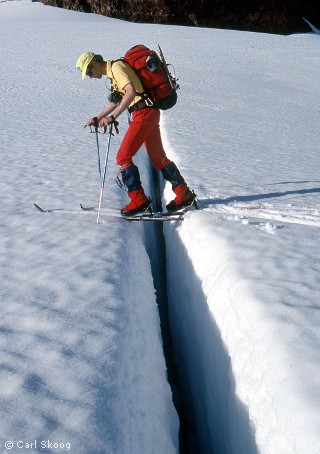
In June 1990, before I knew much about Watson's trip, I traversed Mount Baker in the opposite direction (east to west) with my brother Carl. We camped near the top of the Rainbow Glacier and finished the traverse on our second day. In the years that followed, I became intrigued by "flow days," long one-day ski trips, traveling lightly, that maximized the sensation of continuous movement on skis. I realized that the Mount Baker traverse was an excellent candidate for a flow day (something Dwight Watson had figured out over fifty years earlier). In 1998, I repeated the traverse as a one-day trip with Bruce Goodson. Without thinking much about it, I chose to do the trip again from east to west. In mid-afternoon, standing tiredly on the summit after twelve hours of skinning, I realized that I'd chosen the wrong direction. A mountain range, like a rough piece of wood, has a grain. Skiers accustomed to riding chairlifts or doing short tours are tempted to descend the steeper slopes because that's where the best turns are. But when there is a lot of distance to cover, it is best to ascend the steeps and descend the gentler slopes, because doing so enables you to glide farther. On the Mount Baker traverse, that means going from west to east. Dwight Watson, the wily pioneer, had gotten it right the first time. After I began my ski history research in 2000, I wanted to repeat the traverse Watson's way (see map, 400kb). On June 14, 2004, John Mauro and I drove separately to Mount Baker. We parked John's car at the ski area and shuttled my car to the Kulshan trailhead. We almost aborted the trip during the drive because it was raining so hard. It seemed hopeless that the weather would clear soon enough for our trip. But miracles often happen in the mountains, and when we left my car at 4:15 a.m. the next morning, the sky was clear. We hiked to the Heliotrope moraine and skied up the Coleman Glacier, passing several parties on foot. The previous day's storm had dropped considerable new snow on the peak. The trees on Bastile Ridge were flocked down to 5000 feet and some places on the Coleman Glacier had fresh snow a foot and a half deep. We kicked steps up the Roman Wall in a frigid wind. I had difficulty keeping my fingers warm. It felt like March, not June.
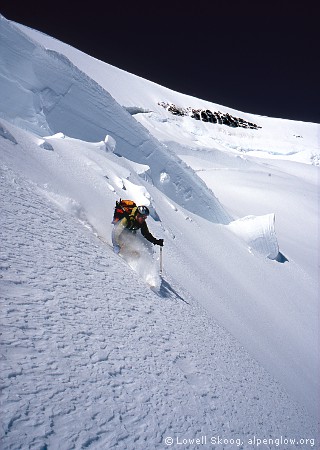
We reached the summit at 9:45 a.m. and studied the route down the Park Glacier from above. Dwight Watson's party had descended northeast from the summit toward The Cockscomb. From there they roped up and belayed each other over the bergschrund at the top of the Park Glacier. John and I considered skiing the Park Glacier Headwall, but we decided against it because of the new snow and uncertain avalanche risk. Instead we skied south toward Sherman Crater, descending a few hundred feet, then worked northeast across the upper Boulder Glacier to the Park Glacier below the headwall. On the Park Glacier we found powder. Powder in mid-June. "Nobody's going to believe us," I told John. We leapfrogged down the glacier taking pictures of each other and savoring the 4000-foot run. We stopped for lunch at the Mazama-Rainbow Glacier saddle and soaked up the warm sun, so different from the cold, windy summit we'd experienced less than an hour earlier. After lunch, we traversed to The Portals and followed the divide to the saddle west of Coleman Pinnacle. We took our boots off to dry and rested on the warm ground there, admiring our marvelous surroundings. Then we shouldered our packs for the last time and continued to Table Mountain, Artist Point, and finally to John's car at the ski area parking lot, arriving at 2:30 p.m. Thanks to slightly sticky snow, we managed the entire route from Mount Baker's summit to the ski area without having to put climbing skins on our skis. We agreed that the Mount Baker traverse is an elegant trip, a real classic. Doing the traverse Watson's way, from west to east, cut my previous one-day traverse time by almost a third. After the trip, I posted a report on the turns-all-year website, applying the name "Watson's Traverse" to the route. I also described the route in the 2010 book Fifty Classic Ski Descents of North America. Since then, the trip has become fairly popular. In May 2014, I recruited friends to ski the route for a movie celebrating the 75th anniversary of Dwight Watson's journey. Our group shared the mountain with scores of other climbers and skiers. Another group making the traverse that day skied the Park Glacier Headwall, first descended on a snowboard by David Orsatti in June 1998. (Martin Volken made the first ski descent a few days later.) Our group followed Dwight Watson's original route down the Cockscomb ridge, for both historical and safety reasons. Although we avoided the steepest part of the headwall, we encountered hard snow-ice on the ridge. A narrow band of softer snow enabled us to sideslip down on skis, without switching to boot crampons. The traverse was as good as I remembered it from ten years earlier, and I was able to replicate scenes from Watson's 1939 movie. I trimmed his 25-minute film to just the shots taken on the traverse, then combined it with scenes from 2014. The results can be seen below. The delight experienced by today's backcountry skiers has made "Watson's Traverse" a living memorial to Dwight Watson. --Lowell Skoog
|
|||||||||||||||||||||||||||||||
|
Previous | Next | Overview - Skiing the Cascade Crest | The Alpenglow Gallery |